ThriveKS
Updated through May 13, 2026
Leavenworth County Data Center Discussion

Understanding the concerns and the proposed county responses.

This page summarizes public concerns raised during Leavenworth County Commission meetings related to proposed data center development and highlights the draft regulatory responses discussed by the County.

The purpose of this page is to help residents navigate the discussion more clearly using publicly discussed information from meeting transcripts and county discussions.

Conceptual View

What a data center campus could include

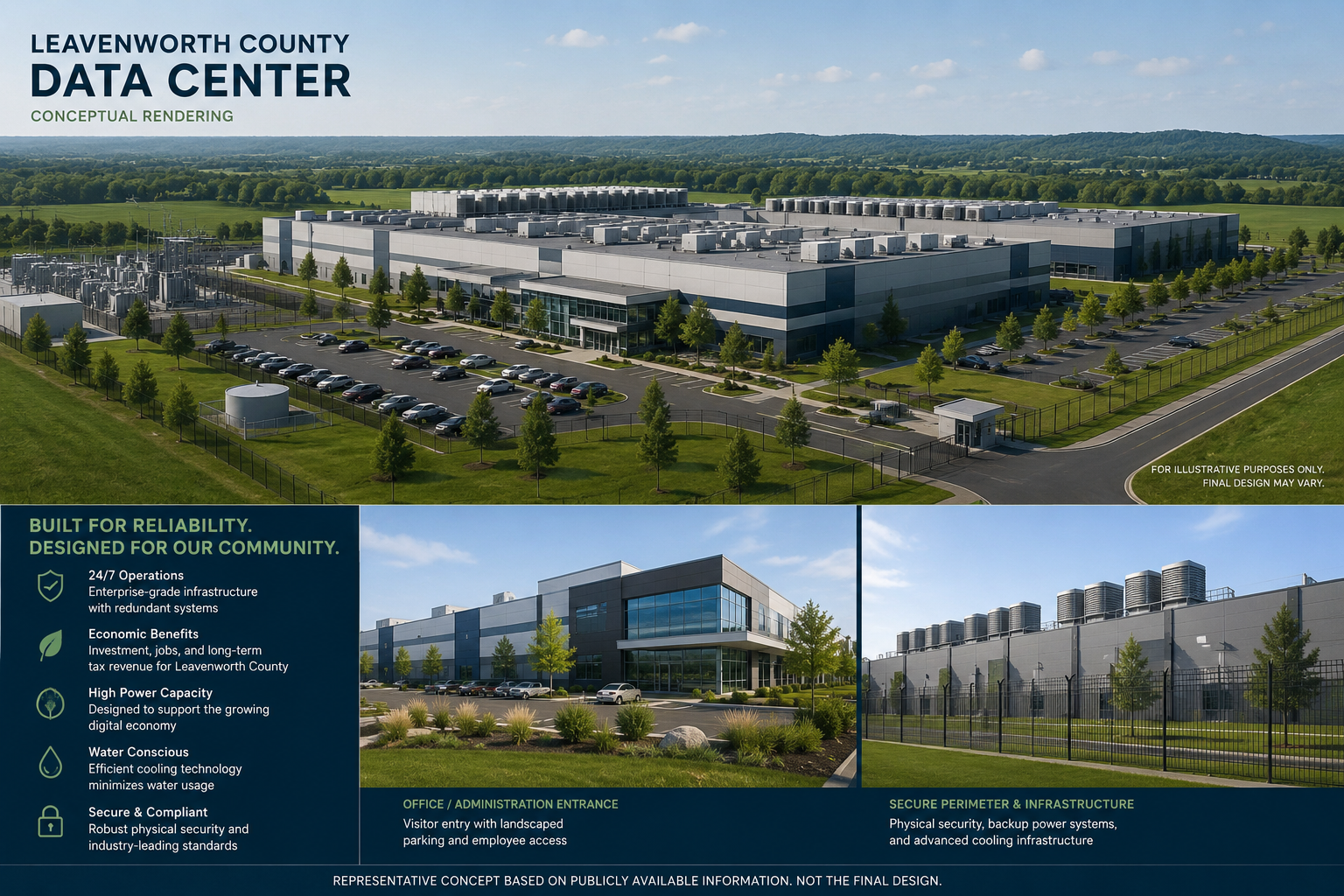
This visual helps residents understand the types of buildings, utility systems, security, parking, cooling equipment, and support infrastructure discussed in the public record.

Conceptual rendering of a modern data center campus with buildings, utility infrastructure, parking, perimeter security, and surrounding green space.
Representative concept image based on transcript themes and publicly discussed infrastructure elements. Not an official rendering. Not the final design. Not an image of the proposed Leavenworth County project.
New May 13 Update

May 13 meeting added: renewed moratorium motion, transparency concerns, and state-level questions

The May 13 meeting added a significant new layer to the public record. Residents continued raising concerns about water, power, noise, taxes, rural character, and environmental impact, but the discussion also shifted heavily toward public trust, developer-provided promotional materials, commissioner neutrality, and whether the County should pause further action while regulations and independent review are completed.

Transcript basis: May 13, 2026 Leavenworth County Commission meeting transcript. This update should be read together with the earlier April and May 6 meeting summaries already reflected on this page.

What residents raised

Public comments focused heavily on water use, power demand, noise, lighting, rural character, transparency, environmental impacts, economic return, property values, construction impacts, long-term growth, commissioner neutrality, and whether the County should pause further action while more information is gathered.

What the County discussed

During the May 6 meeting, draft regulations and standards were discussed. On May 13, commissioners also discussed a renewed moratorium motion, local opposition, state-level policy gaps, water planning, power reliability, and property tax questions.

Why this matters

Data center development is a complex land-use issue. Residents, elected officials, staff, utilities, and developers all need a clear public record to understand the process.

Quick Overview

What the May 6 regulatory discussion covered — and what changed on May 13

The May 6 meeting focused on draft regulatory structure and technical requirements. The May 13 meeting added new discussion about transparency, developer materials, commissioner neutrality, a renewed moratorium motion, state-level water and power questions, and whether local concerns should control the direction of the process.

Proposed regulatory structure

  • Possible Industrial Technology district or data center-specific standards.
  • Public hearing before the Planning Commission.
  • Planning Commission recommendation followed by County Commission final action.
  • Written pre-development and development agreements before final administrative or County Commission action.

Core technical requirements discussed

  • Closed-loop cooling or more efficient technology.
  • Minimum site studies including environmental, water, traffic, sound, wetlands, and geotechnical review.
  • Service availability letters from utility providers.
  • Dark-sky lighting, noise studies, acoustic screening, generator limits, and utility placement standards.

Commissioner follow-up and fact-finding

  • Commissioners stated they had been listening attentively to public concerns.
  • Commissioners discussed visiting data centers and personally checking reported noise issues.
  • Commissioners asked residents to provide written information about other communities so claims could be reviewed.
  • Commissioners compared older facility concerns with newer design standards for lighting and sound mitigation.

May 13 transparency and moratorium discussion

  • Residents questioned developer-prepared materials, fiscal projections, and whether claims were supported by public evidence.
  • Public comments raised concerns about commissioner neutrality and trust in the process.
  • A renewed 90-day moratorium motion was made for Project Blue Stem and related data center, battery storage, or crypto proposals.
  • The discussion also included state-level questions about water planning, power reliability, local control, and property tax policy.

Specific measurable standards discussed

  • Residential lighting spillover discussed at 0.1 foot-candle at adjacent residential property lines.
  • Non-residential lighting spillover discussed at 0.5 foot-candle.
  • Lighting plans subject to third-party review to meet dark-sky goals.
  • Generator testing limited to 11:00 a.m. to 7:00 p.m.; generator use limited to backup and emergency use except testing or commissioning.
  • Post-development noise levels discussed as not exceeding 55 dB over the established baseline at the property line.
Community Concerns & Proposed Responses

Concern-by-concern overview

The sections below summarize major themes raised during public comment and the proposed county responses discussed during the May 6 regulatory review, with May 13 updates where the public record added new emphasis.

Water use, aquifers, and drought conditions

Water was one of the most repeated public concerns across the meetings.

Community concern

  • Residents raised concerns about high water consumption for cooling.
  • Several speakers questioned the effect on aquifers, wells, drought conditions, and drinking-water protection.
  • Public comments asked what happens during water shortages and who receives priority: residents, agriculture, or data center operations.
  • Residents also raised concerns about water contamination, spills, storms, and long-term groundwater consequences.
  • Some speakers argued that more research should be completed before committing local water resources.
  • On May 13, speakers again asked where the water would come from, whether neutral hydrogeologic review would be performed, and whether study results would be published before any vote.

Proposed county response

  • The May 6 discussion included a requirement that data center cooling use a closed-loop system or more efficient technology to limit water usage over the lifespan of the improvements.
  • Cooling systems were discussed as needing to be ecologically friendly.
  • The draft framework required water quality sampling as one of the minimum preliminary studies.
  • Service availability letters from local utility providers were discussed, including water providers where applicable.
  • The County also reserved the ability to request additional studies as impacts are identified during review.
  • On May 13, commissioners discussed whether state-level water planning adequately addresses data centers and whether Kansas has a complete framework for evaluating water impacts.
Transcript basis: April public comments on water and drought risk; May 6 discussion of closed-loop cooling, water quality sampling, utility letters, and additional study authority; May 13 discussion of water-source questions, hydrogeologic review, and state-level water planning gaps.

Electrical demand, grid capacity, and utility infrastructure

Public comments repeatedly questioned whether local and regional infrastructure can support the scale of demand.

Community concern

  • Residents described hyperscale data centers as having electrical demand comparable to a large city.
  • Comments raised concerns about substations, transmission lines, power plants, new easements, and large utility corridors.
  • Some residents worried that utility infrastructure costs could affect ordinary ratepayers.
  • Speakers questioned whether Kansas has enough power capacity for multiple data centers across the state.
  • Residents also discussed the tradeoff between closed-loop cooling and potentially higher electrical demand.
  • On May 13, public comment referenced recent national power-grid reliability concerns tied to data center load behavior and asked whether ratepayers and residential customers would be protected.

Proposed county response

  • The proposed framework categorized data centers by size and energy draw: small, medium, and large.
  • Small-scale facilities were described as 5,000 to 20,000 square feet with 1 to 5 megawatts of draw.
  • Medium-scale facilities were described as up to 100,000 square feet with up to 100 megawatts of draw.
  • Large data centers were described as over 100,000 square feet and over 100 megawatts.
  • The May 6 discussion identified on-site power-related improvements, including transfer switches, backup utility systems, battery energy storage systems, substations, power lines, generators, natural gas facilities, solar projects, and uninterruptible power supplies.
  • Service availability letters were discussed as a requirement to confirm utility capacity and commitment to serve the requested demand.
  • Relevant Kansas Corporation Commission communications were discussed as part of preliminary submittal requirements.
  • On May 13, commissioners discussed whether Kansas law gives residential customers priority over data centers in a power shortage and whether additional public policy is needed.
Transcript basis: public comments on power demand and ratepayer impacts; May 6 discussion of power classifications, utility infrastructure, service availability letters, and Kansas Corporation Commission communications; May 13 discussion of grid reliability, residential priority, and state-level power policy.

Noise, humming, generators, and mechanical equipment

Noise was repeatedly raised as a quality-of-life issue, especially for nearby homes.

Community concern

  • Residents described concerns about a constant 24/7 baseline hum.
  • Comments referenced cooling equipment, generator testing, transformer hum, fans, and operational noise.
  • Speakers worried about sleep disruption and whether rural quiet would be lost.
  • Some residents referenced other communities where noise allegedly affected homes, schools, and daily life.
  • There were also concerns that guided or accompanied tours of other data centers may not fully reflect normal operating noise.
  • Public comments also asked commissioners to make firsthand visits and compare real operating conditions, not only developer-presented examples.
  • On May 13, speakers raised additional questions about natural gas generators, tonal noise, and whether noise claims were being fully studied.

Proposed county response

  • Before the May 6 regulation discussion, a commissioner stated that commissioners had been listening attentively to public testimony and that commissioners had gone to data centers to check the noise concerns themselves.
  • The May 6 discussion included a requirement for a sound or noise study as part of the development plan.
  • The study was described as part of the preliminary review process and reviewable before development.
  • Mechanical equipment on rooftops, ground level, or elsewhere on the exterior was discussed as needing screening when adjacent to residential uses.
  • The draft discussed screening mechanical equipment on all four sides using acoustical barriers.
  • Acoustical barriers were described as exterior solid or louvered walls containing sound-absorbing materials designed to protect neighboring properties from noise.
  • Generator testing was discussed as limited to 11:00 a.m. to 7:00 p.m.
  • Generator use was discussed as limited to backup and emergency use only, except for testing or commissioning activities.
  • Post-development noise was discussed as not exceeding 55 dB over the established baseline at the property line.
Transcript basis: public comments on continuous industrial noise; commissioner remarks about visiting data centers and checking noise; May 6 discussion of sound studies, acoustic barriers, mechanical screening, generator testing limits, emergency-only generator use, and a 55 dB noise standard discussion; May 13 comments about generator type and tonal noise.

Lighting, rural night sky, and visual glow

Residents tied lighting concerns to rural character and quality of life.

Community concern

  • Public comments referenced rural darkness, dark skies, and the desire to avoid industrial glow.
  • Residents worried that large facilities could create light spill, overcast lighting, or visible nighttime disturbance.
  • Residents referenced other communities where lighting was described as making the area feel like daylight at night.
  • Lighting concerns were often connected to broader concerns about the area becoming industrialized.

Proposed county response

  • The May 6 discussion included dark-sky restrictions for new data centers.
  • Lighting would be reviewed as part of the preliminary development plan and final development plan.
  • Lighting components were discussed as being subject to third-party review to achieve dark-sky goals.
  • Residential spillover illumination was discussed at 0.1 foot-candle at the adjacent residential property line.
  • Adjacent non-residential illumination was discussed at 0.5 foot-candle.
  • Glare control was discussed as relying on cut-off luminaires, shields, baffles, mounting height, wattage, aiming angle, and fixture placement rather than vegetation alone.
  • Commissioners discussed an example of updated lighting at a power-company facility where the lighting was described as not creating disturbing overcast light.
  • The discussion also distinguished older data center lighting complaints from newer dark-sky requirements for future facilities.
Transcript basis: public comments on rural lighting impacts; commissioner questions about older data center glow; May 6 discussion of foot-candle standards, glare controls, third-party review, dark-sky restrictions, and initial plan review.

Independent studies, technical review, and developer responsibility

The May 6 discussion included one of the most detailed regulatory responses: required studies before approval.

Community concern

  • Residents repeatedly requested more research before approvals.
  • Public comments asked for hard facts, technical review, and data specific to Leavenworth County.
  • Speakers questioned whether enough is known about long-term environmental, health, water, noise, and infrastructure impacts.
  • Several residents supported a pause or moratorium so studies and regulations could be completed first.
  • On May 13, residents specifically asked whether studies would be neutral, whether results would be published, and whether developer claims would be independently verified.

Proposed county response

  • The May 6 discussion listed minimum preliminary studies required as part of the application process.
  • Those studies included ALTA survey work, geotechnical investigations, wetlands delineations, Phase I environmental site assessment, full environmental impact study, water quality sampling, threatened and endangered species survey, traffic impact analysis, and ambient sound monitoring.
  • The County stated that the list was not necessarily exhaustive and that additional studies may be requested as impacts are identified.
  • The studies were discussed as being performed at the developer’s expense.
  • The studies would then be reviewed by county staff or third parties.
  • On May 13, the renewed moratorium motion was framed as a pause to allow more work sessions, hearings, information gathering, and regulation development before applications are received.
Transcript basis: May 6 discussion of required preliminary studies, developer payment, staff or third-party review, and additional study authority; May 13 comments and moratorium motion seeking more time for review.

Minimum studies specifically discussed on May 6

  • ALTA survey
  • Geotechnical investigation
  • Wetlands delineation
  • Phase I environmental site assessment
  • Full environmental impact study
  • Water quality sampling
  • Threatened and endangered species survey
  • Traffic impact analysis
  • Ambient sound monitoring
  • Additional studies if impacts are identified

Commissioner listening, site visits, neutrality, and evidence requests

The transcripts show that commissioners did more than receive comments; they discussed follow-up, firsthand review, evidence gathering, and on May 13, the public raised new trust and neutrality concerns.

Community concern

  • Residents repeatedly asked commissioners to investigate data centers directly rather than relying only on developer presentations.
  • Speakers questioned whether accompanied tours might be staged or not representative of normal operations.
  • Residents brought examples from other communities involving noise, lighting, construction, and quality-of-life impacts.
  • Several public comments provided or offered outside research, articles, websites, and written materials.
  • On May 13, multiple speakers questioned whether commissioner distribution of developer or utility materials created a perception of advocacy rather than neutral review.
  • Residents asked for disclosure of communications or coordination between county officials and the developer related to messaging or public outreach.

County response discussed

  • A commissioner stated before the May 6 regulation discussion that the commission had been listening very attentively to public testimony.
  • A commissioner stated that commissioners had gone to data centers and checked out the noise concerns raised by the public.
  • Commissioners asked residents to put information in writing when residents described impacts in other communities, so the claims could be reviewed.
  • Commissioners asked follow-up questions about where other data centers were located, how long they had been operating, and what impacts were being reported.
  • Commissioners discussed examples of newer technology and mitigation, including updated lighting and dark-sky requirements.
  • On May 13, commissioners also discussed local opposition, survey results, and whether a nonbinding advisory vote could be used to measure public sentiment.
Transcript basis: May 6 commissioner remarks about listening to public concerns and visiting data centers; April 29 exchange requesting written information about lighting impacts in Ohio; April comments offering outside materials and research; May 13 comments about commissioner neutrality, developer materials, local opposition, and advisory-election discussion.

Transparency, public hearings, moratorium, and decision process

Many residents wanted a clear public process before final decisions. On May 13, the discussion again turned to whether the County should pause before accepting applications.

Community concern

  • Residents expressed concern that the project was moving quickly.
  • Several public comments questioned whether important conversations had already occurred before residents had full information.
  • The identity of the ultimate end user was repeatedly raised as a transparency issue.
  • Speakers asked for written materials, studies, public hearings, and time for residents to review information.
  • Several residents requested a moratorium or pause to allow public review and regulation-building.
  • Residents also asked commissioners to collect written evidence and independently evaluate claims from outside communities.
  • On May 13, speakers specifically challenged developer-prepared handouts, financial projections, and unsupported claims.

Proposed county response

  • The May 6 discussion described a public hearing before the Planning Commission.
  • The Planning Commission would follow a zoning-amendment-style process and forward a recommendation to the governing body.
  • The County Commission would then take final action.
  • Development plans would be required as part of the application process.
  • Additional items could be required at the direction of county staff or the Board of County Commissioners.
  • Commissioners also discussed receiving written information from residents to help evaluate claims from other communities.
  • Pre-development and development agreements would need to be written, accepted, and executed by the Board before final administrative or County Commission action could be granted.
  • On May 13, a 90-day moratorium motion was made to pause further development of Project Blue Stem or other data center, battery storage, or crypto-related proposals while the County considers regulations and gathers more information.
Transcript basis: May 6 discussion of Planning Commission hearing, County Commission final action, development plan requirements, and written development agreements; May 13 renewed moratorium motion and transparency comments.

Rural character, compatibility, and land-use fit

Residents repeatedly emphasized that Tonganoxie and southern Leavenworth County are valued for their rural character.

Community concern

  • Residents described choosing the area because of its rural environment, open land, hospitality, schools, neighbors, and quality of life.
  • Public comments raised concern that the project could turn rural land into an industrial corridor.
  • Speakers referenced large concrete buildings, lights, humming, power infrastructure, and loss of landscape identity.
  • Some residents argued that other uses may better fit the area’s long-term vision and comprehensive plan.
  • On May 13, speakers emphasized that the land should not be treated as vacant or empty, but as an existing ecological and rural landscape.

Proposed county response

  • The May 6 discussion included either data center-specific standards or a standalone Industrial Technology district.
  • The stated purpose of the standards was to limit impacts on surrounding land uses and ensure adequate utilities.
  • The proposed Industrial Technology district was discussed as a way to ensure compatibility with surrounding areas and minimize noise, dust, traffic, light, and negative environmental effects.
  • Permitted uses included technology research and development, light industrial assembly, processing, warehousing, storage operations, maintenance, and technology-related uses tied to data center operations.
Transcript basis: public comments on rural character and land-use compatibility; May 6 discussion of Industrial Technology district standards and purpose language; May 13 comments on rural land, ecosystem value, and community identity.

Traffic, trucks, construction disruption, and road impacts

Construction-related impacts appeared repeatedly in public comments, especially around truck traffic, dust, and road use.

Community concern

  • Residents discussed heavy truck traffic during construction.
  • Public comments referenced dust, road disruption, construction noise, and a multi-year construction period.
  • Speakers questioned how construction and long-term operations would affect local roads, traffic, and daily life.
  • Some comments described the project as much more than one building, including parking, roads, office space, and power infrastructure.
  • On May 13, a speaker described concern about years of traffic delays, diesel fumes, highway congestion, and construction-related disruption.

Proposed county response

  • The May 6 discussion listed traffic impact analysis as one of the required preliminary studies.
  • Parking areas, lots, and structures for employees and visitors were discussed as regulated site improvements.
  • Loading areas for large trucks and equipment were discussed as site elements subject to applicable jurisdictional regulations.
  • The proposed Industrial Technology standards included minimizing traffic impacts as part of compatibility with surrounding areas.
Transcript basis: public comments on trucks, dust, traffic, and construction disruption; May 6 discussion of traffic impact analysis, loading areas, parking, and compatibility standards; May 13 comments on congestion and diesel-fume concerns.

Health, air quality, emissions, environmental impacts, and ecology

Residents connected environmental concerns to health, sleep, air quality, animals, and long-term unknowns.

Community concern

  • Public comments raised concerns about diesel generators, pollutants, air quality, respiratory issues, and potential health effects.
  • Residents referenced sleep disruption, infrasound, circadian rhythm disruption, and possible health consequences near industrial operations.
  • Several speakers said there is not enough long-term research on the impacts of large-scale data centers.
  • Concerns were also raised about animals, livestock, wildlife, native grass, and environmental stewardship.
  • On May 13, speakers described the site as habitat for species and argued that the land has ecological value that should be considered before development.

Proposed county response

  • The May 6 discussion included sustainable construction practices and best management practices for site improvements and structures.
  • A full environmental impact study was listed as one of the minimum preliminary studies.
  • A Phase I environmental site assessment was also listed as a required preliminary study.
  • Threatened and endangered species survey requirements were discussed.
  • Generator rules adjacent to residential property were referenced during the discussion.
Transcript basis: public comments on health and environmental risk; May 6 discussion of environmental studies, best management practices, species survey, and generator-related standards; May 13 comments on wildlife, habitat, and ecological protection.

Property values, property taxes, and nearby homes

Several residents raised concerns about nearby homes, land values, personal financial impact, and property-tax burden.

Community concern

  • Residents living near the proposed area questioned what the project would do to property values.
  • Some residents said their home or land represents their primary wealth and long-term security.
  • Public comments raised concerns that nearby residential property could become harder to sell or less desirable.
  • Speakers also questioned whether property-value changes could affect county revenue over time.
  • On May 13, residents also connected the data center debate to senior citizens, foster grandparents, and the pressure of property taxes on households.

Proposed county response

  • The May 6 discussion addressed compatibility with adjacent residential land uses through noise, lighting, screening, and site-review standards.
  • Mechanical equipment screening was specifically discussed for properties adjacent to existing or planned residential development.
  • Public hearing and development review procedures were discussed as part of the approval process.
  • The proposed framework addressed impacts on surrounding land uses, though property-value analysis itself was not the main focus of the May 6 technical discussion.
  • On May 13, the state senator and commissioners discussed property tax policy, whether data centers would pay property tax, and the relationship between local tax base growth and household tax pressure.
Transcript basis: April comments on property-value concerns; May 6 discussion of residential-adjacent mitigation, compatibility standards, and public development review; May 13 comments on property taxes, household burden, seniors, and tax-base questions.

Schools, churches, and sensitive nearby uses

Some residents specifically asked how a data center could affect schools, churches, and nearby community institutions.

Community concern

  • Public comments asked about proximity to Tonganoxie High School, Tonganoxie Middle School, and surrounding churches.
  • Speakers questioned how noise, traffic, light, air quality, and construction activity could affect these nearby institutions.
  • Residents also connected schools and churches to the broader community character and family-oriented identity of the area.

Proposed county response

  • The May 6 discussion did not focus specifically on schools or churches as a separate category.
  • However, the proposed framework included compatibility standards, traffic impact analysis, sound studies, lighting restrictions, and environmental review that could apply to nearby sensitive uses.
  • Public hearing procedures would give residents and nearby institutions an opportunity to participate in the formal review process.
Transcript basis: April public comments on schools, churches, and proximity concerns; May 6 discussion of general compatibility, sound, lighting, traffic, and public hearing procedures.

Cryptocurrency mining and related facilities

The May 6 discussion directly addressed whether crypto mining would be allowed, and the May 13 moratorium motion also referenced crypto-related facilities.

Community concern

  • Cryptocurrency mining was raised because it is often associated with high energy use, noise, and speculative industrial operations.
  • A commissioner asked directly whether cryptocurrency would be included in the proposed framework.
  • On May 13, the renewed moratorium motion included data center proposals, battery storage facilities, and crypto-related facilities.

Proposed county response

  • Planning staff responded that cryptocurrency was not included.
  • Staff stated that cryptocurrency mining would be a prohibited use under the proposed standards.
  • This was one of the clearest direct responses discussed during the May 6 meeting.
  • The May 13 moratorium motion proposed pausing data center, battery storage, and crypto-related proposals while the County considers regulations and gathers more information.
Transcript basis: May 6 exchange regarding cryptocurrency mining as a prohibited use; May 13 renewed moratorium motion referencing data center, battery storage, and crypto-related proposals.

Taxes, incentives, Senate Bill 98, and public benefit

Residents repeatedly discussed whether incentives and tax policy change the true value of the project for the public.

Community concern

  • Public comments criticized state-level incentives and exemptions connected to data centers.
  • Several speakers referenced Senate Bill 98 and the idea that the project would not be in Kansas without state incentives.
  • Residents questioned sales tax exemptions, property tax benefits, abatements, and whether local taxpayers would receive enough return.
  • Some comments raised concerns that multinational companies could receive large public benefits while local communities absorb long-term impacts.
  • There were also concerns about whether economic projections are reliable and whether benefits are proportional to public costs.
  • On May 13, residents questioned developer financial projections, whether hardware or infrastructure would be taxed, and whether the public had the full fiscal picture.

Proposed county response

  • The May 6 regulatory discussion focused primarily on land use, site standards, utilities, studies, and operational impacts.
  • Economic incentives and state tax policy were discussed in public comments, but the proposed regulations were not primarily a tax-policy document.
  • The regulatory framework would still affect public benefit by shaping what must be reviewed, studied, mitigated, and approved before a project can proceed.
  • Development agreements were discussed as written agreements requiring Board acceptance and execution before final action.
  • On May 13, state-level discussion addressed whether data centers would pay property tax, whether sales-tax exemptions apply to construction and equipment, and whether local officials should give away property-tax revenue.
Transcript basis: public comments on SB98, incentives, abatements, and public benefit; May 6 discussion of regulatory standards and development agreements; May 13 discussion of fiscal projections, property tax, sales tax exemptions, and state-level incentives.

Jobs, construction work, and long-term economic return

Residents debated whether the economic return would justify the scale of the project.

Community concern

  • Public comments questioned how many permanent jobs would be created after construction.
  • Some residents argued that construction jobs are temporary and may rely on outside workers.
  • Speakers questioned whether the long-term return is proportional to the land, water, power, roads, and public attention required.
  • Some comments suggested alternative forms of development may better support local businesses, housing, tourism, agriculture, or community-serving industries.
  • On May 13, residents questioned changing project-size figures, job estimates, full buildout assumptions, and whether a long-term tax benefit would actually continue if technology changes.

Proposed county response

  • The May 6 discussion did not appear to resolve the economic-return debate directly.
  • The proposed regulations focused on whether and how a facility could be reviewed, studied, conditioned, and mitigated through land-use standards.
  • By requiring studies, utility confirmation, development agreements, public hearings, and site standards, the County discussed mechanisms that could help inform future cost-benefit evaluation.
  • On May 13, the debate expanded to include whether developer claims should be independently reviewed before the County relies on projected tax revenue or job figures.
Transcript basis: public comments on jobs, economic return, and opportunity cost; May 6 discussion of process and regulatory review structure; May 13 comments on changing project scale, jobs, tax revenue, and technology risk.

Future expansion, multiple buildings, and long-term buildout

Residents often framed the issue as larger than one building or one phase.

Community concern

  • Public comments expressed concern that one data center could lead to additional buildings or a larger campus.
  • Residents referenced other communities where data centers clustered and expanded over time.
  • Some speakers worried that the full buildout could change the direction of the County Road 1 corridor and surrounding area for generations.
  • Comments also referenced large amounts of land marketed or potentially available for industrial development.
  • On May 13, residents questioned shifting descriptions of project scale, including references to hundreds of megawatts, possible gigawatt-scale demand, and larger acreage.

Proposed county response

  • The May 6 discussion emphasized that the regulations were being written for data centers generally, not only one specific project.
  • The draft framework identified site improvements and infrastructure that could accompany data center campuses, including power, cooling, broadband, parking, loading, maintenance, solar, and utility systems.
  • The discussion included small, medium, and large data center definitions, which would help classify future proposals by scale.
  • The County also discussed development plans and development agreements as part of the review process.
  • On May 13, a renewed moratorium motion proposed pausing not only Project Blue Stem but other similar proposals while the County considers regulations and gathers more information.
Transcript basis: public comments on expansion and cumulative impact; May 6 discussion that standards were being written for data centers generally, not only one specific project; May 13 comments on project scale and renewed moratorium scope.

State policy, local control, and whether Kansas has a complete framework

The May 13 meeting added a broader discussion about whether state-level policy has kept pace with large-scale data center development.

Community concern

  • Residents questioned whether state incentives are encouraging projects before local communities have adequate regulations.
  • Speakers discussed Senate Bill 98, sales tax exemptions, state-level tax policy, and whether residents had meaningful input before those incentives were adopted.
  • Concerns were raised about whether the Kansas Corporation Commission, Kansas water planning, and other state agencies are fully evaluating cumulative data center impacts.
  • Residents and commissioners asked whether Kansas has a clear statewide answer on how many data centers can be sustained, especially regarding water and power.

County and state response discussed

  • A commissioner stated that the Department of Commerce had said local community opposition should be respected and that data centers should not be pushed onto local communities.
  • The state senator stated that local control should govern the decision and that local officials must decide whether the proposal is right for the community.
  • Commissioners discussed whether a state-level moratorium or broader state framework may be needed while agencies catch up to the scale and speed of the issue.
  • Discussion included whether Kansas law protects residential customers ahead of data centers during power shortages and whether additional public policy is needed.
Transcript basis: May 13 discussion with state senator and commissioners regarding local control, state incentives, water planning, KCC role, power reliability, property taxes, and statewide policy gaps.

What could be included on a data center site

The May 6 discussion listed many potential site improvements, showing the County was not treating the issue as just one building.

Community concern

  • Residents repeatedly stated that a data center is more than a server building.
  • Public comments referenced roads, power lines, substations, generators, cooling equipment, parking, construction, and supporting infrastructure.
  • Residents wanted the County to understand and regulate the full operational footprint.
  • On May 13, residents again questioned whether promotional materials fully explained the size, acreage, energy demand, easements, buildings, water systems, and infrastructure involved.

Proposed county response

  • The May 6 discussion identified site improvements that could be located on a data center site.
  • These included ATS systems, backup utility systems, battery energy storage, chillers, cooling towers, electric power facilities, fencing, security, fiber broadband, generators, natural gas facilities, parking, loading, maintenance facilities, solar energy projects, uninterruptible power supplies, and public or private utilities.
  • This portion of the discussion showed that the County was considering the broader campus and infrastructure components connected to data center operations.
Transcript basis: May 6 list of data center site improvements and related infrastructure; May 13 comments about the full project footprint and whether promotional materials fully described the proposal.
Process Snapshot

How the review process was described

The May 6 discussion described a process involving technical materials, public hearing, recommendation, and final action. On May 13, a renewed 90-day moratorium motion sought to pause further applications while the County continues work sessions, hearings, regulation development, and information gathering.

Step 1

Applicant submits a development plan, minimum required studies, utility service availability letters, and related materials.

Step 2

County staff and/or third-party reviewers examine the studies and may request additional information as impacts are identified.

Step 3

The Planning Commission holds a public hearing and forwards a recommendation through a zoning-amendment-style process.

Step 4

The County Commission receives the recommendation and takes final action, with development agreements required before final approval.

Source Notes

Meetings reflected in this page

This page is written from meeting transcript summaries and should be paired with direct transcript links or timestamps before publication.

Transcript record used for this summary

This page is based on the public comment themes and County discussion reflected in Leavenworth County Commission meeting transcripts from April 1, April 8, April 15, April 22, April 29, May 6, and May 13, 2026. The May 6 transcript is especially important because it includes the discussion of proposed data center regulations. The May 13 transcript is especially important because it includes renewed moratorium discussion, concerns about developer materials and public trust, and state-level discussion about property taxes, water, power, and local control.

To review the meeting videos directly, visit the ThriveKS Source Library.

Open Source Library